DIRECT-TO-PART PRINTING
Industrial UV flatbed printers from Automark allow you to print high-resolution graphics, logos, braille, and variable data directly onto plastic, metal, glass, and more — with instant UV curing and no plates required.
TECHNOLOGY OVERVIEW
Industrial UV flatbed printers are direct-to-part printing systems that use ultraviolet light to instantly cure specialized inks as they are deposited onto a surface. Unlike traditional printing methods that rely on drying time or heat, UV flatbed printers harden ink in milliseconds — delivering sharp, durable graphics directly onto finished parts without additional processing steps.
The defining advantage of UV digital printing systems is their ability to print on an exceptionally wide range of rigid materials. Because UV ink cures on the surface rather than absorbing into it, these printers can decorate plastics, metals, glass, acrylic, wood, coated substrates, and many other industrial materials with equal effectiveness.
Direct-to-part UV printing eliminates the need for plates, screens, or lengthy changeover times. This makes it ideal for short-to-mid production runs, custom graphics, variable data, and rapid design changes — while still delivering professional, repeatable results at industrial scale.
Prints cure immediately for faster handling and production.
Decorate plastic, metal, glass, wood, acrylic, and more.
Produce sharp text, logos, graphics, and fine detail.
Repeatable results for industrial parts and branded products.
MATERIAL COMPATIBILITY
UV printing systems from Automark are compatible with a broad range of rigid industrial materials. If you don’t see your substrate listed, send us a sample — we’ll test it.
Aluminum, stainless steel, anodized surfaces, and powder-coated metals. UV printers for metal produce sharp legends, logos, and safety markings that withstand industrial environments.
ABS, polycarbonate, PVC, and molded plastic components used in electronics, medical devices, industrial controls, and consumer products. .
Decorative glass, flat panels, signage substrates, and product packaging. UV printers for glass deliver vibrant, durable graphics with excellent adhesion.
Drinkware, USB drives, phone cases, branded merchandise, and custom awards. Short runs and variable data make UV printing ideal for promotional decoration.
Control panel faceplates, instrument housings, equipment labels, and rated nameplates requiring durable direct-to-part marking.
Aluminum, stainless, and acrylic nameplates with full-color UV printing. Durable output withstands harsh industrial environments and outdoor exposure.
Raised braille dots and tactile graphics printed directly onto sign substrates using multi-layer UV ink. Explore our dedicated UV braille printing for ADA signage page.
Stone and tile products with flat or raised lettering using full-color UV printing. Explore our dedicated UV braille printing for ADA signage page.
APPLICATION VALIDATION
Before you invest in equipment, Automark can help evaluate whether industrial UV flatbed printers are the right fit for your specific part, material, and production requirements. In many cases, we can test your actual parts — verifying adhesion, print quality, and durability — and provide video documentation of the results so you can see real output before making any decision.
We assess your substrate, geometry, and print requirements before recommending any equipment.
Send us your actual production parts and we'll test print them on industrial UV flatbed printers.
We verify ink adhesion and durability on your specific material — not just generic samples.
We provide video documentation of your sample print results so your team can evaluate output quality.
APPLICATION FIT
Use this guide to quickly evaluate whether UV flatbed printing fits your parts and production requirements.
If your application falls between these categories, Automark can help determine the best printing process before you invest in equipment.
INDUSTRIES AND USE CASES
Industrial UV flatbed printers serve a wide range of manufacturing sectors. Each application below represents a common use case where UV digital printing systems deliver measurable value.
Apply logos, part numbers, regulatory markings, and decorative graphics to plastic electronics enclosures, keyboard overlays, and consumer device housings. UV printers for plastic parts deliver chemical-resistant, durable results on ABS, polycarbonate, and PVC.
Learn More →Apply durable, high-resolution markings to medical device housings, diagnostic equipment, and regulated healthcare products. UV printing supports traceability requirements and biocompatible ink options for medical applications.
Learn More →Print raised braille dots and tactile graphics directly onto sign substrates using multi-layer UV ink deposition. UV printers for ADA braille signage eliminate the need for separate embossing or raster braille processes.
Learn More →Print labels, legends, safety markings, and operator instructions directly onto control panel faceplates, switch housings, and instrument panels. UV printing for metal and plastic panels delivers chemical-resistant, long-lasting results.
Learn More →Decorate drinkware, USB drives, phone cases, awards, and branded merchandise with full-color UV printing. Short runs and variable data make UV printing ideal for custom promotional product decoration.
Learn More →Produce industrial nameplates, equipment placards, asset tags, and rating plates with full-color UV printing on aluminum, stainless steel, acrylic, and other nameplate substrates. Durable output withstands harsh industrial environments.
Learn More →KEY ADVANTAGES
Industrial UV flatbed printers offer a combination of print quality, material flexibility, and production efficiency that few other marking technologies can match.
Print up to 2,880 DPI for sharp text, fine detail, photographic images, and precise logos on industrial parts and products.
UV inks cure immediately under UV lamps, eliminating drying time and allowing parts to be handled right after printing for faster production cycles.
Print CMYK full-color graphics, smooth gradients, photographic images, and complex artwork directly onto parts — no color limitations.
Digital workflow means design changes are made in software — no new plates, screens, or setup costs. Switch jobs in minutes, not hours.
One machine handles plastic parts, metal components, glass panels, promotional products, medical devices, and more — without retooling.
Apply raised braille dots and tactile textures using multi-layer UV ink deposition — ideal for ADA braille signage and accessibility applications.
Learn More →SIDE-BY-SIDE COMPARISON
Understanding which printing process fits your application is critical before investing in equipment. Automark can help you make the right choice.
| Feature | UV Flatbed Printing | Pad Printing |
|---|---|---|
| Print Quality | ✓ Up to 2,880 DPI full-color, gradients, photos | ✓ Sharp single/multi-color, excellent on curves |
| Design Flexibility | ✓ Digital — instant changes, no tooling | ✗ Requires new plate per design change |
| Material Compatibility | ✓ Flat/slightly curved rigid substrates | ✓ Complex curves, irregular surfaces |
| Color Capability | ✓ Full CMYK + white + gloss | ~ Limited colors per pass |
| Braille / Texture | ✓ Multi-layer raised printing | ✗ Not suitable |
| Short Run Cost | ✓ No setup cost — 1-piece minimum | ~ Plate cost amortized over run |
| Variable Data | ✓ Full variable data per piece | ✗ Not practical |
| Production Speed | ✓ Fast for complex graphics | ✓ Very fast for high-volume single-color |
| Best For | Full-color, variable, flat/near-flat parts | High-volume, curved, single/multi-color parts |
Not sure which process is right for your application? Automark evaluates your parts and recommends the best solution — including when pad printing is the better choice.
PRODUCTION PLANNING
Understanding realistic throughput expectations is essential when evaluating industrial UV flatbed printers for your production environment.
Applications requiring a white underbase, gloss coating, or raised braille require additional passes, which increases production time. Factor this into throughput planning for complex print jobs.
Throughput depends heavily on how efficiently parts are nested on the print bed. Larger parts or single-part runs produce fewer pieces per hour than tightly nested smaller parts.
Full-coverage prints require more ink and slightly longer cure times than simple logos or text. Artwork complexity directly affects cycle time per piece.
Automark provides application-specific throughput estimates based on your part, layout, and quality requirements — so you can plan production accurately before purchasing equipment.
Higher DPI settings produce finer detail but require more passes and reduce throughput. Operators can balance speed and quality based on the specific application requirements.
Batching multiple small parts on a single print bed dramatically increases effective throughput. Efficient fixturing and nesting are key to maximizing production speed.

BUYER'S GUIDE
Selecting the right UV printing system depends on several key factors. Use this guide to narrow your options before speaking with an Automark specialist.
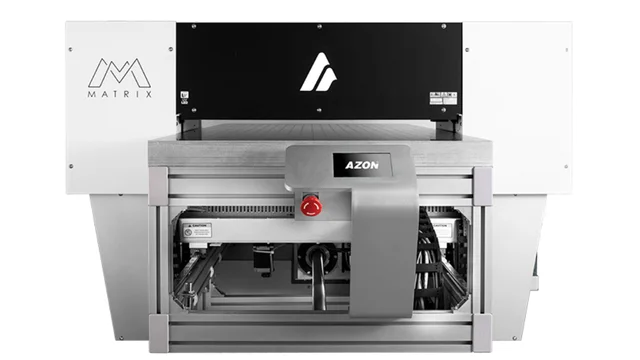
The physical dimensions of your parts determine the minimum print bed size required. Measure your largest part and ensure the printer's print area accommodates it with room for fixturing. For oversized parts, consider the Matrix UV series with its large-format bed.
Estimate your daily or weekly part volume. The Edge UV is ideal for low-to-mid volumes and R&D environments. The Razor Hale handles mid-volume industrial production. The Matrix UV is designed for high-throughput operations.
All Automark UV flatbed printers handle a wide range of rigid substrates. Specific ink formulations and surface preparation requirements vary by material. Automark evaluates your substrate and recommends the appropriate ink system.
If your application requires photographic-quality output, fine text, or precise logos, ensure the selected printer supports the resolution needed. All Automark systems print up to 2,880 DPI.
If your application requires raised braille dots or tactile textures, ensure the selected printer supports multi-layer UV ink deposition. All Automark systems support braille printing.
Consider whether you need a compact desktop unit for R&D and short runs, a mid-size industrial system for production, or a large-format platform for high-volume continuous printing.
HOW IT WORKS
If you’re evaluating industrial UV flatbed printers for your application, here is exactly what happens when you contact Automark.
Share your part, substrate, geometry, production volume, and print requirements. You can send physical samples or provide detailed specifications.
Our application team reviews your substrate, part geometry, print area, and production goals to determine whether UV flatbed printing is the right fit.
In many cases, we test print your actual parts on industrial UV flatbed printers, verify adhesion and durability, and document the results with video proof.
Based on your application evaluation, we recommend the specific UV printing system, ink configuration, and workflow that best fits your production environment.
With real test results, a written application assessment, and a clear equipment recommendation, you can make a confident, informed purchasing decision.
WHY AUTOMARK
Automark is not just a machine reseller. We are an application partner — and we will tell you when UV printing is not the right process for your parts.
We evaluate your application before recommending equipment. Our goal is to find the right solution for your parts — not to sell you a machine that doesn't fit.
We can test your actual production parts on industrial UV flatbed printers, verify adhesion and durability, and provide documented results before you commit to a purchase.
We provide video documentation of your sample print results so your team can evaluate output quality and share results internally before making a purchasing decision.
Since 2013, Automark has supported manufacturers across medical, aerospace, automotive, electronics, and consumer goods industries with industrial printing and marking solutions.
If UV printing is not the right process for your application, we will tell you — and recommend the process that actually fits, whether that's pad printing, laser marking, or another technology.
Our team is based in Katy, Texas, with same-day response on technical inquiries, stocked consumables for fast shipping, and in-person demonstration capability throughout North America.
RECOMMENDED SYSTEMS
Browse Automark’s lineup of industrial UV flatbed printers — from compact desktop units to large-format systems designed for high-volume production environments.
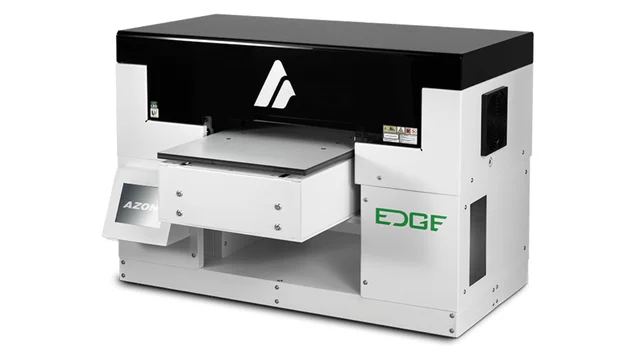
Compact UV flatbed printer designed for direct-to-product printing on small parts and promotional products.
Pricing varies depending on configuration, ink options, and accessories.
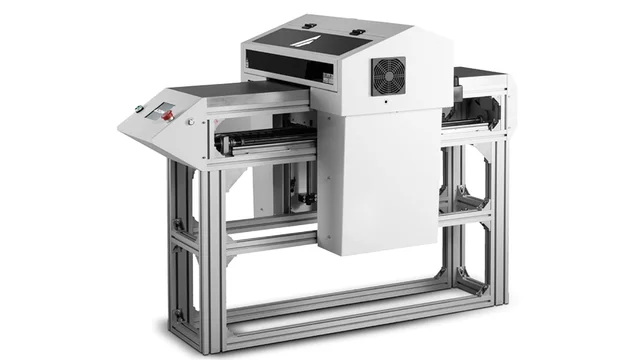
Mid-size UV flatbed printer for industrial part marking, product decoration, and medium-volume production.
Pricing varies depending on configuration, ink options, and accessories.
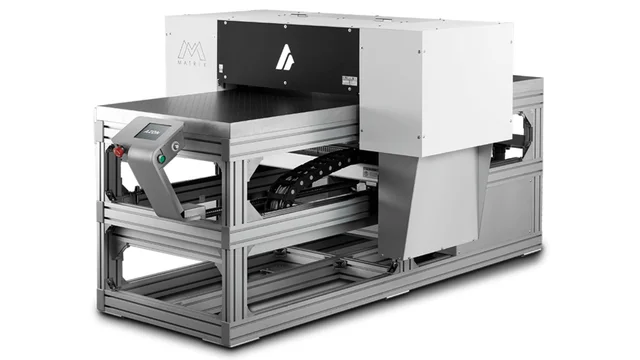
Large-format UV flatbed printers built for high-volume industrial marking and product decoration.
Pricing varies depending on configuration, ink options, and accessories.
TEST BEFORE YOU BUY
If you are unsure whether industrial UV flatbed printers are right for your product, Automark can help evaluate the application. In many cases, we can test sample parts, verify adhesion, and provide a video so you can see the results before investing in a machine.
FREQUENTLY ASKED QUESTIONS
Answers to the most common questions buyers ask when evaluating industrial UV flatbed printers for their application.
Industrial UV flatbed printers can print on a wide range of rigid materials including ABS, polycarbonate, acrylic, PVC, aluminum, stainless steel, anodized metals, glass, wood, ceramic, coated substrates, and many other surfaces. Because UV inks cure instantly on contact with UV light, they adhere to the surface rather than absorbing into it — making UV printing suitable for materials that are difficult to decorate with traditional methods.
Yes. UV printers for plastic parts are one of the most common industrial applications. UV flatbed printers can print on ABS, polycarbonate, acrylic, PVC, polypropylene, and most engineering plastics. Durability depends on the ink formulation, surface preparation, and application environment. Automark tests adhesion and durability on your specific plastic parts before recommending a solution.
Yes. UV printers for metal can print on aluminum, stainless steel, anodized surfaces, coated metals, and powder-coated housings. UV printers for glass deliver vibrant, durable graphics on flat glass panels, signage substrates, and decorative glass products. Surface preparation requirements vary by material — Automark evaluates your specific substrate and recommends the appropriate ink system and pre-treatment process.
Yes. Industrial UV flatbed printers can print raised braille dots and tactile textures by applying multiple layers of UV ink in the same pass. This capability makes UV printing a practical solution for ADA braille signage, wayfinding panels, and accessibility-compliant product labeling without the need for separate embossing or molding processes. Learn more about our UV braille printing for ADA signage.
It depends on your part geometry, production volume, color requirements, and design flexibility needs. UV flatbed printing excels for full-color graphics, variable data, flat or near-flat surfaces, and applications requiring design flexibility. Pad printing excels for complex curves, high-volume single-color runs, and parts where UV printing cannot reach. Automark can evaluate your specific application and recommend the right process — including when pad printing is the better choice.
The right UV flatbed printer depends on your part size, production volume, material requirements, print quality needs, and budget. Automark provides application-specific guidance to help you select the right system. Key factors include print bed size relative to your largest part, daily production volume, ink configuration requirements (white ink, gloss, braille), and whether you need a compact desktop unit or a large-format industrial system.
Yes. Automark's sample print program allows you to send your actual production parts for testing on industrial UV flatbed printers. We verify adhesion and durability on your specific substrate, provide video documentation of the results, and deliver a written application assessment — all at no obligation to purchase. This is the most reliable way to confirm that UV printing will work for your specific application before investing in equipment.
READY TO GET STARTED?
Send us your part or application details. We’ll help you determine the best approach, evaluate whether UV printing is the right fit, and show you real results before you make an investment.
Or call +1(512) 593-7100 to speak directly with a UV expert.
Send us your information below and we’ll get back to you within one business day.
Send us your part or application details. We’ll help you determine the best approach, evaluate whether UV printing is the right fit, and show you real results before you make an investment.